Scientific researchers discovered that even moderate leisure‑time activity cuts coronary heart disease and stroke risk by ~20–30%. Regular cardio can even regulate blood pressure and lead to a stronger heart.
If you decide to work on your condition but don’t know where to start you’re at the right place. Let us guide you through the 20 best cardio exercises in the gym and at home.
Cardio Exercises in Gym
Walking on a treadmill with an Incline
Walking on a treadmill with an incline is a low-impact but very effective form of cardio that strengthens the legs and glutes while placing extra demand on the heart without stressing the joints.
The intensity goes from low to moderate, so it is suitable for beginners, people wanting to lose weight, and anyone returning to training after a break. Set the incline, keep your posture upright, and walk at a steady pace.
Walking with an incline is known to be more effective for weight loss than running. Not because it magically burns more calories per minute but because an average person can do it for a longer period of time.
Also, running tends to stress the body more than walking, and for beginners that leads to harder recovery and burnout, while incline walking helps them ease in, recover better, and actually enjoy training.

Running on a treadmill
Running on a treadmill is a classic cardio workout that improves cardiovascular endurance, burns calories efficiently, and helps build lower-body strength.
The intensity can range from moderate to high. It depends on speed and intervals you choose and that’s why running generally suits intermediate and advanced trainees as well. Beginners should start with short running intervals and learn to run with a relaxed upper body, and to maintain a consistent rhythm or interval pattern.
Rowing on Ergometer (rowing machine)
Rowing on an ergometer is a powerful full-body cardio exercise that works the legs, back, arms, and core while also challenging the heart and lungs. The intensity of regular rowing outdoors is really high, but the good side of ergometer is that you can adjust it. However, it’s best suited for intermediate to advanced fitness levels, though beginners can row at a slower pace to learn technique.
Push through the legs first, then pull the handle toward your torso, and return smoothly to the starting position.
Elliptical Trainer
The elliptical trainer provides a smooth, joint-friendly cardio workout that mimics running without impact, making it ideal for longer sessions and steady-state cardio. The intensity is low to moderate and works well for beginners, recovery days, or anyone with joint sensitivity. Move your arms and legs in sync, keep your posture tall, and adjust resistance to control effort.
We feel the need to mention that this is an excellent leg exercise as well. While on a trainer you’ll be activating glutes, quads, hamstrings, calves, hip flexors, adductors, and abductors.
The stair climber
The stair climber is a demanding cardio machine that targets the glutes and legs while quickly elevating heart rate, making it excellent for conditioning and fat loss. The intensity is high, so it’s better suited for intermediate to advanced trainees or shorter sessions for beginners. Step continuously at a controlled pace, avoid leaning on the rails, and drive through your legs.
Cycling indoors
Cycling on an indoor cycle is a versatile cardio option that builds leg endurance and cardiovascular fitness with minimal joint stress. The intensity while cycling indoors can also range from low to very high. It’s a great cardio exercise for all fitness levels.
Just pedal smoothly, keep a steady cadence, and adjust resistance to match your training goal.
The air bike
The air bike is a high-intensity cardio machine that challenges both the upper and lower body at the same time. It’s an excellent choice for when you’re doing a full body workout split and want to add cardio as well.
It is extremely effective for conditioning and HIIT workouts. The intensity is very high and best suited for advanced trainees or short, intense intervals. Push and pull the handles while pedaling hard, letting your effort dictate the resistance.
Battle ropes
Battle ropes are a conditioning exercise that raises heart rate fast while building endurance in the arms and core. It is a really good shoulder exercise as well. It’s recommended to intermediate to advanced trainees, though beginners can use shorter intervals. Hold the ropes firmly and create powerful waves or slams while keeping your knees slightly bent.
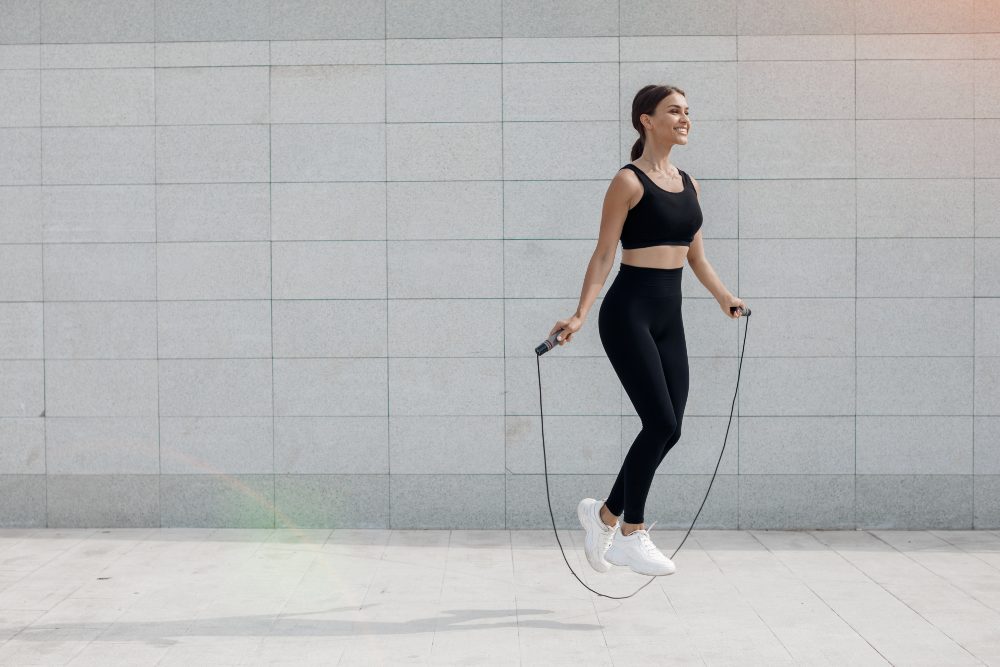
Jump rope in the gym
Jump rope in the gym is a simple but highly effective cardio exercise that improves coordination, foot speed, and cardiovascular endurance.
The intensity is moderate to high but suits most fitness levels with proper progression. Jump lightly on the balls of your feet, keep your elbows close to your sides, and let your wrists control the rope.
Sled Pushes and Pulls
Sled pushes or pulls are a strength-based cardio exercise that builds power, leg strength, and conditioning at the same time. The intensity is high and ideal for intermediate to advanced trainees looking for athletic conditioning. Lean forward, brace your core, and drive the sled forward with strong, controlled steps.
If you want to learn more about cardio workouts at the gym read our blog.
Cardio Exercises at Home
Marching in Place
Marching in Place is simply walking in place, but it’s surprisingly effective for gently raising your heart rate and warming up your joints without stressing the knees. The intensity is low, so it’s perfect for beginners, anyone coming back after a break, or as a warm-up before harder cardio. Stand tall, swing your arms naturally, and march on the spot while gradually lifting your knees a little higher and picking up the pace.
Jogging in Place
Jogging in Place is the next step up from marching and gives you a steady cardio boost even if you don’t have space to run. The intensity is moderate and suits beginners to intermediate trainees, depending on how fast you move and how much you use your arms. Jog lightly on the spot, land softly, and keep your arms pumping to help maintain rhythm and raise your heart rate.
High Knees
High Knees are a more intense version of jogging in place, great for getting your heart rate up quickly while also engaging your core and hip flexors.
The intensity is high, so it’s best for intermediate to advanced fitness levels, or beginners who keep it controlled and slower. Run on the spot while driving your knees up toward hip height, keeping your chest lifted and your core tight.
Jumping Jacks
Jumping Jacks are a classic full-body cardio move that warms you up fast, improves coordination, and works well in both fat-burning circuits and simple home workouts. The intensity is moderate, making it beginner-friendly, but it can become high-intensity if you speed it up and jump higher. Jump your feet out as your arms sweep overhead, then jump back to the start as your arms return to your sides.
Mountain Climbers
This is a fast-moving cardio and core exercise that also fires up the shoulders and legs. It is great for when you want intensity without all the fancy gym equipment. The intensity while mountain climbers is high and it fits intermediate to advanced trainees, while beginners can slow it down to build control first.
Start in a strong plank and alternate driving your knees toward your chest, switching legs quickly while keeping your hips steady.
Burpees
Burpees are a full-body conditioning exercise that builds endurance, power, and mental toughness because it consists of a squat, a plank, and a jump into one continuous flow.
The intensity is very high, so it’s best for intermediate to advanced levels, while beginners should use a step-back version and skip the jump at first. Drop into a squat, place your hands down, kick your feet back to a plank, return to squat, then stand and jump up.
Squat Jumps
Squat Jumps are a lower-body power move that spikes your heart rate while targeting glutes, quads, and calves, which is why they’re great for HIIT and athletic conditioning. The intensity is high and it’s most suitable for intermediate to advanced trainees, especially if your knees tolerate jumping well. Squat down with control, then explode upward into a jump and land softly back into the next squat.

Speed Skaters
With this cardio exercise you train the heart and lungs while improving balance and working the outer thighs and glutes.
The intensity of speed skaters is moderate to high, so it’s great for intermediate trainees, and beginners can do it as quick side steps instead of jumps. Leap to one side, land on one foot, swing the other leg behind you, then immediately switch to the other side.
Jump Rope (or Air Jump Rope)
Jump Rope (or Air Jump Rope) is a simple but brutal cardio tool that improves rhythm, footwork, and calf endurance, and it burns calories fast in a short time. The intensity is moderate to high depending on speed, so it suits most levels—beginners start slow, advanced trainees go for intervals. Jump lightly on the balls of your feet with small bounces while keeping your elbows close and your wrists doing the “turning.”
Inchworms
Inchworms are a full-body move that blends cardio with mobility, especially for the hamstrings, shoulders, and core, so it’s perfect when you want sweat and flexibility in one exercise.
The intensity is low to moderate and works for beginners through advanced, since you control the pace and range of movements. Stand tall, hinge forward to the floor, walk your hands out to a plank, then walk your feet back in and stand up again.
FAQ About the Cardio Exercises
How much cardio is recommended to a beginner?
If you’re yet to gain condition and are a complete beginner with cardio, start with two to three sessions a week. They should last around 10 to 20 minutes. It shouldn’t be a too intensive activity in the beginning, try brisk walking or cycling for start.
If you have a health condition, we strongly recommend consulting your doctor first, and then training with a professional personal trainer who will bear in mind your current state and adjust cardio exercises accordingly.
Is it better to do cardio before or after workouts?
There isn’t one perfect order for everyone. For endurance or cardiovascular performance, doing cardio first helps you perform better, but for building strength and developing muscles it’s usually better to do weights first and cardio after so your muscles are fresh and recovery is easier.
Find a more detailed answer on a “cardio before or after workout” question in our blog.
Should I do it on separate days?
Yes, doing cardio and strength training on separate days is often the best option if you want better performance and time to recover. When cardio and workouts are split into different days, your body can fully focus on each. Performance while lifting weights will be higher and cardio will feel easier.